I’m currently finishing edits on my third book, The Road That Knows No End.
- One of those editing passes is among the least glamorous—and most revealing.
- I go hunting for words.
- Not misspelled words. Not incorrect words. The perfectly innocent little words that show up so often they eventually stop serving the story and start waving at the reader.
- Words like something, thing, just, really, perfectly, actually, and
- They aren’t bad words. Sometimes they’re exactly the right words.
- But use one often enough—or several times within a few paragraphs—and suddenly you can hear it.
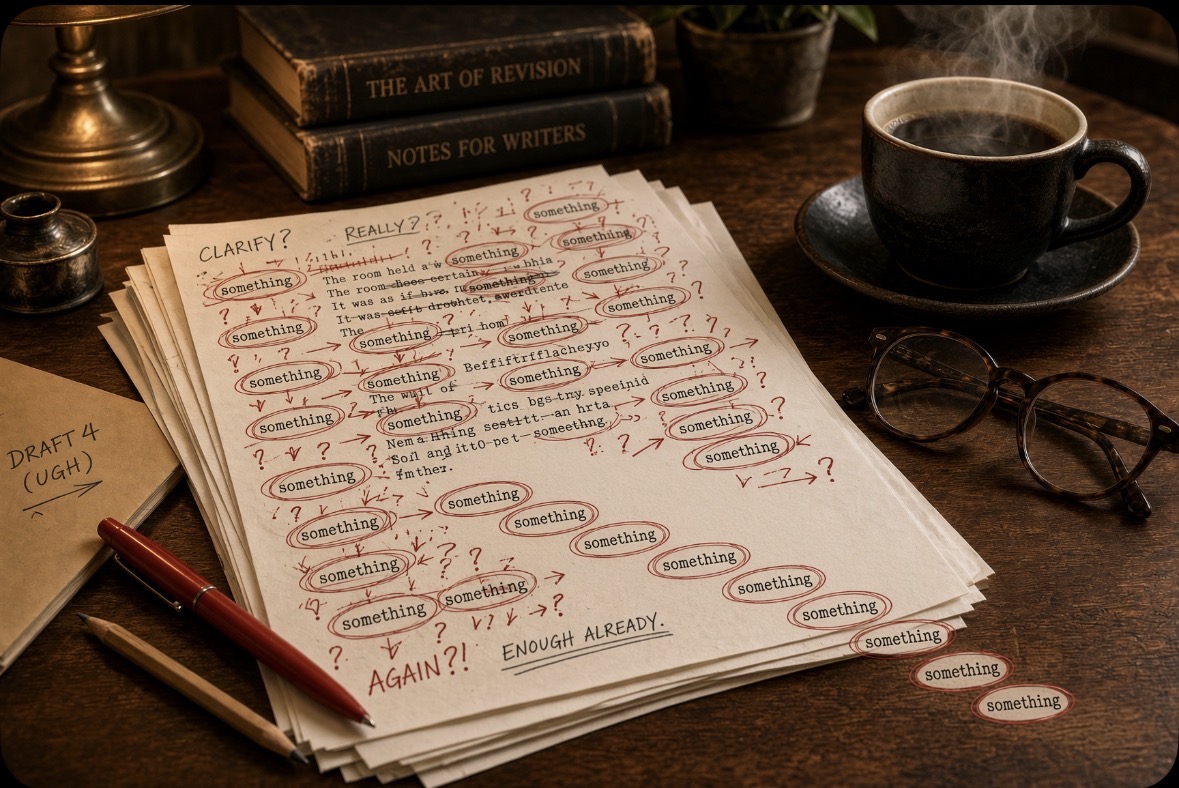
- In this manuscript, “something” appeared 158 times.
- One hundred and fifty-eight.
- That’s not a word.
That’s a marching band.
- At that volume, “something” can stop conveying mystery or uncertainty and start becoming a little white flag:
- I know what I mean, but I haven’t quite landed the sentence yet.
The Words That Become Our Crutches
And “something” isn’t alone.
“Thing” is always willing to help keep matters vague. “Perfectly” likes to sneak in when one of my characters is being a little too tidy. “Just” pretends it’s harmless and then quietly multiplies when nobody is looking.
Of course, I’m not talking about ordinary function words like the, and, or of. Those are supposed to appear constantly. Even a word like said can repeat quite happily without calling much attention to itself.
- I’m talking about the words that become our
- Our crutches.
- And I first became aware of those years ago at Toastmasters.
What Table Topics Taught Me
Table Topics—still my favorite part of a Toastmasters meeting—is the impromptu round where someone hands you a surprise question and you have to stand up and talk about it.
- No preparation. No script.
- One week, someone added an extra challenge:
- Answer a descriptive question without using the words “very” or “thing.”
- We failed
- Someone said “thing” before finishing the first sentence. Someone else said it twice and then apologized with another “very.”
- The room laughed because we recognized ourselves.
- The exercise did exactly what it was supposed to do.
- It made the crutches visible.
- Toastmasters is great for that.
- Just wait until someone starts counting your “ums.”
- Or your “so…”
- Writing a novel simply turns the same spotlight on a much longer speech.
Placeholder or the Right Word?
The interesting part is that these words aren’t crimes. I don’t automatically delete every “something” I find.
- Sometimes something really is something.
- But other times it’s a placeholder. It holds the chair while the real word is still out in the hallway putting on its coat.
- And that’s when I stop.
- What does the character actually see?
- What exactly are they feeling?
- What moved?
- What changed?
- What is the something?
Sometimes I replace it with a more precise word. Sometimes I rewrite the sentence. Sometimes I decide the vagueness is intentional and leave it exactly where it is.
The point isn’t to eliminate the word.
It’s to notice it.
Because when the same distinctive word keeps appearing—especially when several instances sit close together—the reader may begin to hear the repetition even if they can’t quite explain what’s bothering them.
So now I keep a running list of my repeat offenders.
- “Something” is currently the ringleader.
- “Perfectly” is under surveillance.
- And I don’t trust “just” for a minute.
Your Turn
- If you write, what are the words that show up in your drafts like they own the place?
- The ones you don’t even notice until the 80th appearance?
- Misery loves company.
- And if you’ve never tried answering a descriptive question without using “very” or “thing”… consider yourself warned.
- It’s harder than it looks.
Resources
- Toastmasters International: Toastmasters
- Inger E. Johnson’s author platform and podcast: Your Book Is In There
About the Author
Inger E. Johnson is the author of Veiled Halos and The Muzo Emerald Murders and the host of Your Book Is In There, a podcast and author platform that helps first-time writers finally write the book they can’t stop thinking about.